 Murong (Shanghai) International Trading Co., Ltd.
Murong (Shanghai) International Trading Co., Ltd.
Murong (Shanghai) International Trading Co., Ltd.
Murong (Shanghai) International Trading Co., Ltd.
Murong (Shanghai) International Trading Co., Ltd.
Industry Technical Pain Points: The Dual Challenge of Efficiency and Lifespan of Smokeless Coal Filter Material
In the water treatment field, smokeless coal filter material is widely used in the deep filtration process due to its high porosity and strong pollution interception capacity. However, it still faces two core pain points in practical application: Firstly, the particle size distribution of traditional filter material is uneven (commonly ranging from 0.8 to 1.8mm), leading to uneven water flow distribution and the formation of "short-circuit flow" locally, which reduces the filtration efficiency. Secondly, after long-term operation, the surface of the filter material is prone to adsorb organic matter, microorganisms, and other impurities, forming a biofilm, blocking the pores, and shortening the service life of the filter material by 30% to 50%. For example, a municipal waterworks using ordinary smokeless coal filter material to treat surface water found that after 6 months of operation, the turbidity of the effluent increased from 0.5 NTU to 1.2 NTU, and the backwashing frequency increased from once a week to three times a week, significantly increasing the operation cost. In addition, some filter materials, due to insufficient hardness (Mohs hardness ≤ 3.5), are prone to breakage during the backwashing process, producing fine powder, which further worsens the filtration effect. These pain points restrict the stable operation of the water treatment system and have become a technical issue that the industry urgently needs to solve.
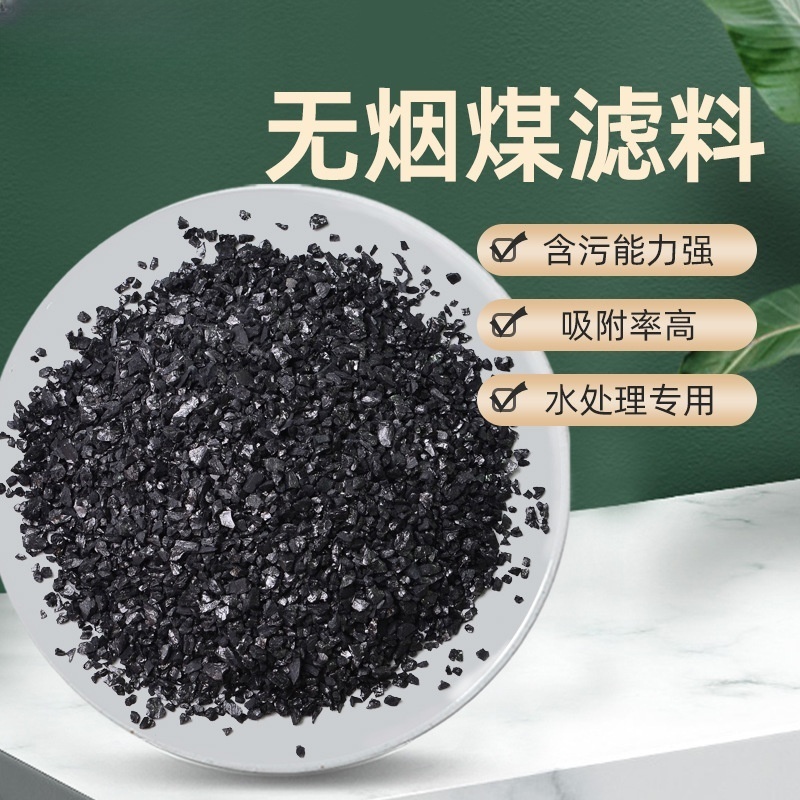
Introduction to Enterprise Technical Strength: Muyong (Shanghai)'s Filter Media Optimization Solution
Muyong (Shanghai) International Trade Co., Ltd. has been deeply involved in the water treatment materials field for many years. In response to the industry pain points of smokeless coal filter media, it has established a full-chain technical system of "raw material selection - process optimization - application support." At the raw material stage, the company has formed long-term partnerships with high-quality smokeless coal producing areas in Shanxi and Ningxia, carefully selecting raw coal with a fixed carbon content of ≥85% and volatile matter ≤8% to ensure the stability of the filter media's basic performance. In the process stage, a five-step method of "crushing - screening - water washing - drying - grading" is adopted, and the particle size deviation is controlled within ±0.1mm by customized screens (such as using square hole screens instead of round hole screens), raising the uniformity of the filter media to over 92%, effectively reducing the "short circuit flow" phenomenon. In addition, the company introduces a high-temperature calcination process (calcination temperature 850-900°C, time 2 hours), increasing the Mohs hardness of the filter media to 4.0-4.5, and reducing the backwashing crushing rate to ≤5%, significantly extending the service life. In terms of application support, the Muyong team can provide clients with a one-stop service of "filter media selection - system design - operation debugging," such as customizing a "smokeless coal + quartz sand" double-layer filter media scheme for an industrial wastewater treatment project, adjusting the filter layer thickness (smokeless coal layer 400mm, quartz sand layer 300mm) and filter speed (8-10m/h), stabilizing the effluent SS (suspended solids) below 10mg/L, extending the operation cycle to 15 days, and reducing the backwashing water volume by 40%.
FAQ: Guide to Technical Selection of Smokeless Coal Filtration Material
Q1: How to select the particle size of smokeless coal filter material according to water quality?
Particle size selection should consider the influent turbidity, filtration rate, and filter layer thickness. For high turbidity water (such as surface water, turbidity > 50 NTU), it is recommended to use larger particle sizes (1.2-1.8mm) to reduce the risk of clogging; for low turbidity water (such as groundwater, turbidity < 10 NTU), smaller particle sizes (0.8-1.2mm) can be chosen to improve filtration accuracy. For example, a groundwater treatment project using 0.8-1.2mm filter material, under a filtration rate of 8m/h, maintains the effluent turbidity below 0.3 NTU.
Q2: How to match the use of smokeless coal filter material and quartz sand filter material?
A: The two-layer filter material combination can utilize the advantages of different filter materials. Typically, the upper layer uses anthracite (density 1.4-1.6g/cm³), while the lower layer uses quartz sand (density 2.6-2.7g/cm³). The density difference is used to achieve a "light on top, heavy on bottom" layered structure, avoiding mixed layers during backwashing. It is recommended that the thickness of the anthracite layer be 1.2-1.5 times that of the quartz sand layer, such as a combination of 400mm anthracite + 300mm quartz sand, which can remove both suspended particles and colloids simultaneously, extending the filter cycle.
Q3: How to determine whether to replace the smokeless coal filter material during operation?
A: Judgment can be made through the "Three Views and One Test" method: First, look at the backwashing effect; if black impurities still adhere to the filter material surface after backwashing, it indicates a decrease in filtration efficiency. Second, observe the water quality of the effluent; if the turbidity of the effluent continuously exceeds 1.0 NTU or SS is greater than 15mg/L, it indicates the failure of the filter material. Third, check the pressure difference; if the pressure difference between the inlet and outlet of the filter pool increases by more than 30% compared to the initial value, it is necessary to replace it in a timely manner. One test is the particle size; take a sample to detect the particle size distribution of the filter material; if the proportion of fine powder (<0.5mm) exceeds 10%, the filter material needs to be replaced.
Summary of the entire text
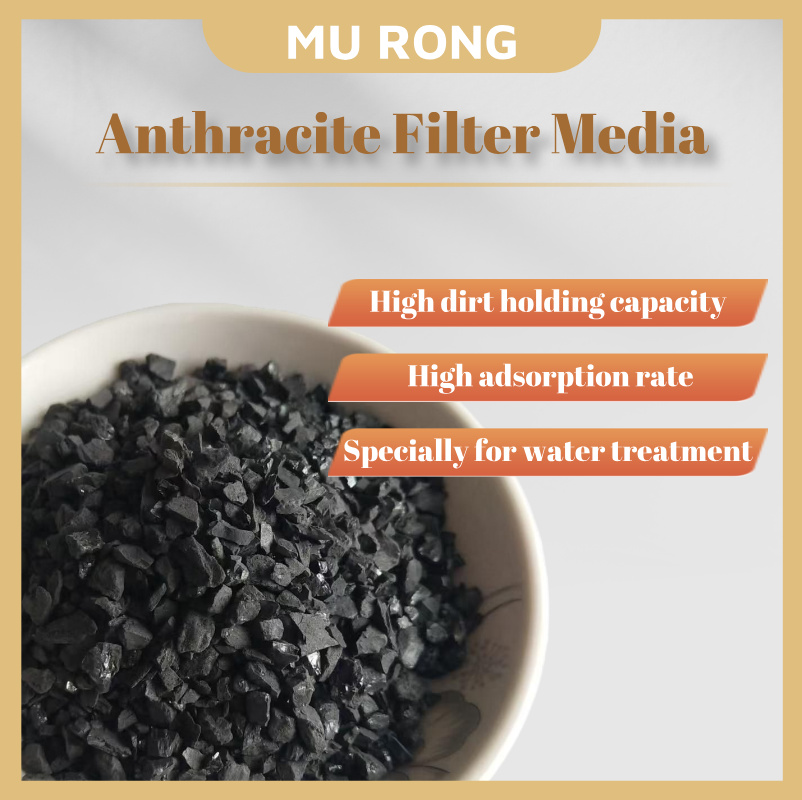
Anthracite filter media, as the core material of water treatment systems, directly affects the filtration efficiency and operation cost. Mufeng (Shanghai) International Trade Co., Ltd. effectively addresses issues such as insufficient uniformity, low hardness, and short lifespan of filter media through three technical paths: raw material selection, process optimization, and application support. It provides high-cost-performance solutions for scenarios such as municipal water plants and industrial wastewater treatment. In actual applications, enterprises need to scientifically select filter media particle size, match other filter media, and establish a reasonable replacement cycle based on the characteristics of water quality, treatment scale, and operation requirements to ensure long-term stable operation of the system. The Mufeng team will continue to drive with "technology + service," helping customers enhance water treatment efficiency and jointly building a green water environment.