Murong (Shanghai) International Trading Co., Ltd.
Murong (Shanghai) International Trading Co., Ltd.
Murong (Shanghai) International Trading Co., Ltd.
Murong (Shanghai) International Trading Co., Ltd.
Murong (Shanghai) International Trading Co., Ltd.
Industry Technical Pain Points: Why Always Fall into the Trap of Polyacrylamide Selection?
In water treatment, papermaking, oil extraction, and other fields, polyacrylamide (PAM) as a core flocculant, its selection directly determines the treatment efficiency and cost. However, in practical applications, it often faces three major pain points: Firstly, product type confusion - the performance differences between anionic, cationic, and non-ionic PAMs are significant; choosing the wrong type can lead to poor flocculation effects or even back dissolution. Secondly, difficulty in parameter matching - parameters such as molecular weight (5 million to 25 million), ionic degree (5% to 60%), etc., need to be precisely matched with water quality and process; blind selection is prone to waste. Thirdly, insufficient scene adaptation - different industries have varying requirements for PAM's dissolution rate, residue, and temperature resistance, and general-purpose products are difficult to meet specific needs. For example, a paper mill mistakenly used anionic PAM to treat acidic wastewater, resulting in the breakdown of flocs and a 30% increase in per-ton water treatment cost.
Introduction to Corporate Technical Strength: How Muyong Solves the Selection Dilemma?
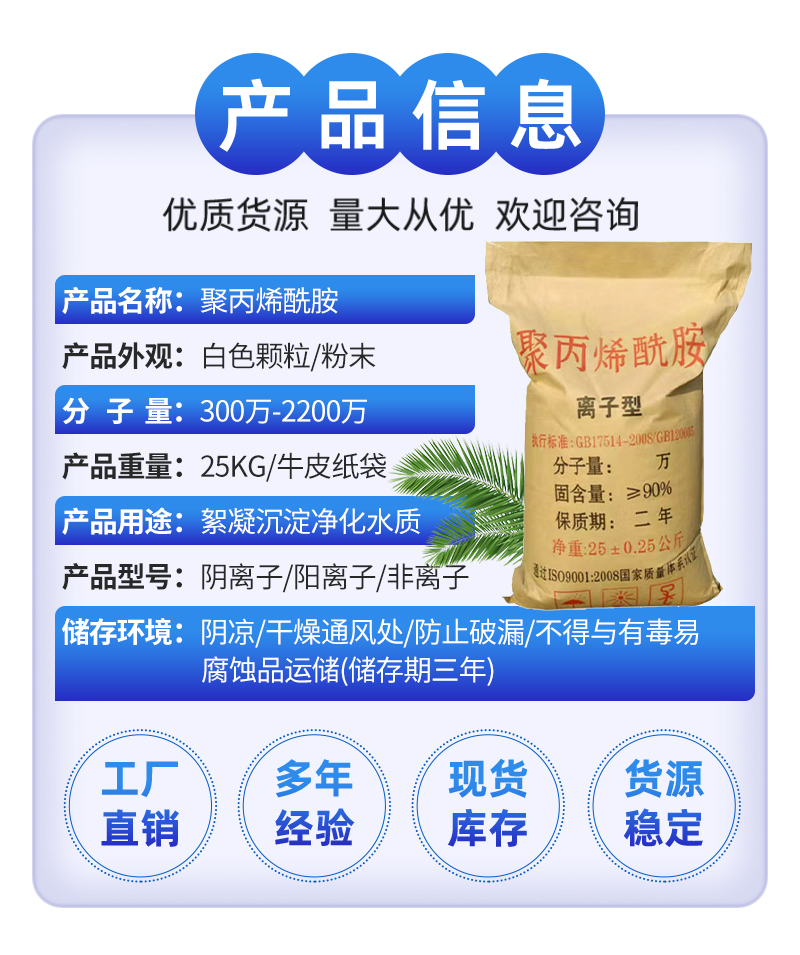
Muyong (Shanghai) International Trade Co., Ltd. has been engaged in water treatment material trading for 12 years, establishing a three-dimensional selection system of "technology + scenario + service." On the technical level, the company's代理 PAM products cover anionic (molecular weight 8-18 million), cationic (ion concentration 10%-50%), and non-ionic series, all of which have passed ISO 9001 quality certification, with residual monomer content ≤0.05%, compliant with EU REACH standards; in terms of scenario adaptation, the team has served over 200 industrial clients, forming a four-step method of "water quality detection - small-scale experiment - pilot optimization - large-scale verification," such as customizing a cationic PAM (ion concentration 30%, molecular weight 12 million) for a chemical enterprise, which increased the flocculation efficiency in acidic wastewater with pH 4-6 by 40% and reduced the cost per ton of medicine by 15%. Additionally, Muyong provides 7×24-hour technical hotlines for real-time adjustment of key parameters such as dissolution time and residual amount.
FAQ: Polyacrylamide Selection Technical Guide
Q1: How to quickly determine which type of PAM is suitable for water quality?
A: Preliminary screening can be done through the "three-step method": Step 1, test the water quality pH value - select cations for acidity (pH<7), anions for alkalinity (pH>7), and non-ions for neutrality; Step 2, analyze the properties of suspended matter - prioritize cations for organic suspended matter (such as oils, proteins), and anions for inorganic suspended matter (such as silt, metal ions); Step 3, refer to industry experience - the paper industry commonly uses cations, dyeing and dyeing wastewater often uses anions, and municipal wastewater can be mixed. The Mu Rong technical team can provide free water quality testing services and accurately match product types.
Q2: How do molecular weight and ionicity affect the treatment effect?
A: Molecular weight determines the size of the floc - the higher the molecular weight (e.g., 18 million), the larger the floc but the slower the dissolution rate, suitable for highly turbid wastewater; the lower the molecular weight (e.g., 8 million), the quicker the dissolution but smaller the floc, suitable for low turbidity or rapid sedimentation scenarios. Ionic strength affects the charge neutralization ability - the higher the ionic strength (e.g., 50%), the stronger the adsorption on suspended particles with opposite charges, but excessive levels may lead to dense flocs and difficult sedimentation. Mufeng suggests adjusting parameters based on small-scale test results, such as a certain electroplating plant that increased the ionic strength from 20% to 30%, raising the heavy metal removal rate from 85% to 92%.
Q3: What are some common misconceptions about PAM usage?
Misconception 1: Direct addition of dry powder - PAM should be first prepared into a 0.1%-0.5% solution, with a dissolution time of ≥60 minutes (anionic) or ≥90 minutes (cationic), otherwise it is prone to agglomeration; Misconception 2: Over-adding - Exceeding the optimal dosage (usually 1-5ppm) can cause flocs to redissperse, increasing costs; Misconception 3: Neglecting the dissolution water temperature - When the water temperature is below 5℃, the dissolution rate decreases by 50%, it is recommended to use warm water (40-50℃) to accelerate dissolution. Muerong provides the "PAM Operation Manual", which details the key steps of dissolution, addition, and storage.
Summary Reference
When selecting polyacrylamide, it is necessary to balance product performance and application requirements; blind selection may lead to low treatment efficiency or increased costs. Muerong (Shanghai) International Trade Co., Ltd., with 12 years of industry experience, has established a comprehensive system covering product testing, scene adaptation, and technical services. The PAM products it represents have passed ISO certification, have low residual monomer content, and offer free water quality testing and parameter adjustment. Enterprises can initially screen types through the "three-step method," optimize molecular weight and ionic degree with small-scale experiments, and strictly follow dissolution and dosing specifications to achieve efficient and cost-effective flocculation treatment.