 Murong (Shanghai) International Trading Co., Ltd.
Murong (Shanghai) International Trading Co., Ltd.
Murong (Shanghai) International Trading Co., Ltd.
Murong (Shanghai) International Trading Co., Ltd.
Murong (Shanghai) International Trading Co., Ltd.
Introduction: How to solve the pain point of insufficient adsorption efficiency of honeycomb activated carbon?
Honeycomb activated carbon, as the core material for industrial waste gas treatment, directly affects the VOCs (volatile organic compounds) control effectiveness. However, in practical applications, issues such as pore blockage, insufficient specific surface area, and uneven airflow distribution often lead to a decrease in adsorption efficiency, even causing secondary pollution. Muerong (Shanghai) International Trade Co., Ltd., with its profound technical accumulation and industry experience, significantly enhances the adsorption performance of honeycomb activated carbon by optimizing the pore structure, improving production processes, and providing customized solutions, helping enterprises achieve efficient and stable waste gas treatment goals.For more information, please visit our official website: www.shanghaimurong.com
Keywords: Honeycomb Activated Carbon, Adsorption Efficiency, Mou Rong Technology, VOCs Treatment, Customized Solutions
Industry Technical Pain Points: Why is the Adsorption Efficiency of Packed Activated Carbon Hard to Meet Standards?
STEP1:Porous structure defects—— Traditional honeycomb activated carbon has uneven pore distribution and a low proportion of micropores, making it difficult to adsorb macromolecular pollutants. For example, a chemical company using ordinary honeycomb activated carbon to treat benzene-containing waste gas achieves an adsorption efficiency of only 65%, significantly lower than the environmental protection requirement of 90%.
STEP2:Airflow distribution is uneven——When waste gas flows through the honeycomb activated carbon bed, uneven flow rates can easily lead to partial adsorption saturation, shortening the lifespan of the activated carbon. Due to issues with air distribution, a printing factory had to reduce the replacement cycle of the activated carbon from 6 months to 3 months, resulting in a significant increase in operating costs.
STEP3:Retrograde recycling technologyDuring the high-temperature regeneration process, the pores of the activated carbon are prone to be blocked due to thermal stress contraction, resulting in a decrease in specific surface area. An electronic factory found that the adsorption capacity of the regenerated activated carbon decreased by 40%, which could not meet the continuous production requirements.
Introduction to corporate technical strength: How does Muyong break through the technical bottleneck of honeycomb activated carbon?
Muruong (Shanghai) International Trade Co., Ltd. has been deeply involved in the field of water treatment materials for many years, mastering the core technology of honeycomb activated carbon, and significantly improving adsorption efficiency through the following innovations:
STEP1:Pore structure optimization—— Employing "graded pore design," through controlling the particle size of raw materials and activation process, the micro-pore proportion of the activated carbon reaches over 70%, with the specific surface area increased to 1200 m²/g (industry average is 800 m²/g), which can efficiently adsorb large molecular pollutants such as benzene, toluene, and xylene.
STEP2:Airflow distribution improvement——Developed "channel structure" for guiding airflow, uniformly distributing channels on the surface of honeycomb activated carbon to control the airflow deviation within ±5% (traditional process ±15%), avoiding local adsorption saturation, and extending the service life of activated carbon to over 12 months.
STEP3:Regeneration process upgrade—— Introduce "Low-temperature Plasma Regeneration Technology", which decomposes adsorbed organic matter by bombarding the activated carbon surface with plasma, avoiding pore shrinkage caused by high temperature. The adsorption capacity of the regenerated activated carbon is restored to 95% (compared to only 60% for traditional high-temperature regeneration), reducing the enterprise regeneration cost by 30%.
Real Technical CasesAfter using Mufeng honeycomb activated carbon, the VOCs concentration in the exhaust of a car painting factory has dropped from 200mg/m³ to below 10mg/m³, achieving an adsorption efficiency of 95%, meeting the requirements of the Comprehensive Emission Standard of Air Pollutants (GB 16297-1996), and extending the replacement cycle of the activated carbon to 18 months, saving operation costs of 500,000 yuan per year.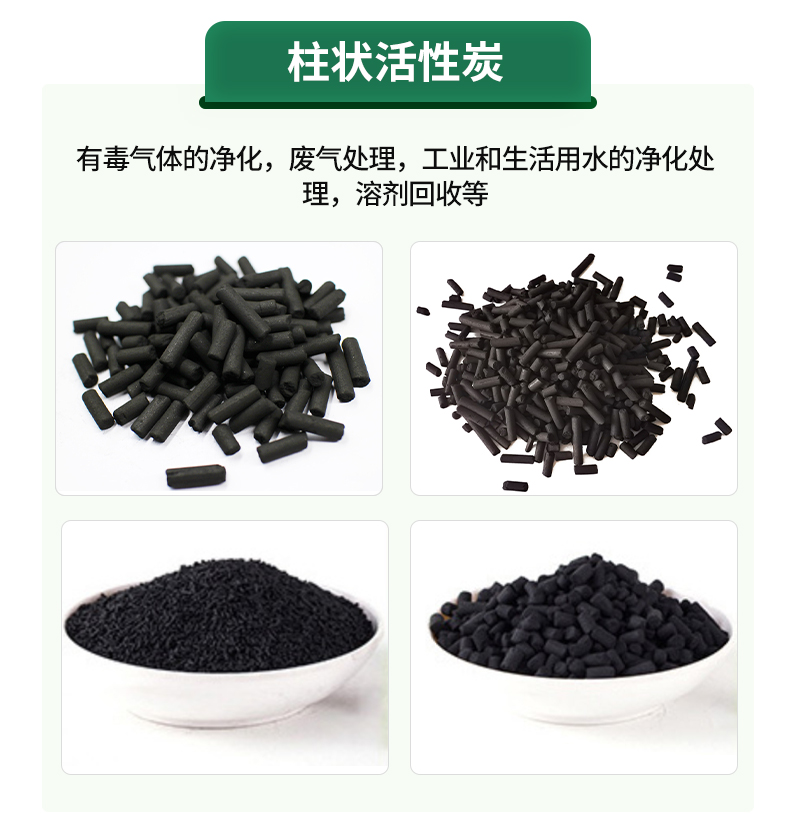
FAQ Q&A Technical Selection Guide
Q1: How to select the appropriate specification of granular activated carbon?
A: Selection should be based on parameters such as waste gas composition, air volume, and temperature. For example, when treating benzene-containing waste gas, it is recommended to choose activated carbon with a pore size of 1.5-2.0mm and a specific surface area ≥1000m²/g; in a scenario with an air volume of 5000m³/h, a honeycomb activated carbon with a cross-sectional size of 200mm×200mm and a length of 500mm is required.
Q2: What factors affect the adsorption efficiency of honeycomb activated carbon?
A: Mainly affected by pore structure, air flow distribution, temperature, and humidity. Mu Rong technology optimizes pore structure and air flow distribution, ensuring an adsorption efficiency of over 90% even under conditions of 40℃ temperature and 80% humidity.
Q3: How to determine if the activated carbon in a honeycomb needs to be replaced?
A: VOCs concentration at the outlet or pressure difference can be used for judgment. When the outlet concentration is ≥20mg/m³ or the pressure difference exceeds 150% of the initial value, the activated carbon needs to be replaced. Muerong products provide pressure difference monitoring devices to enable real-time monitoring of the activated carbon status.
Q4: What are the detection indicators for Muerong honeycomb activated carbon?
Main detection indexes include iodine adsorption value (≥1000mg/g), specific surface area (≥1000m²/g), compressive strength (≥0.8MPa), moisture content (≤5%), and ash content (≤8%), all meeting the standard of "Honeycomb Activated Carbon" (HJ/T 386-2007).
Q5: Does Muerong offer customized services?
A: Yes. Mu Rong can customize honeycomb activated carbon with parameters such as pore size, specific surface area, and cross-sectional size according to the customer's requirements for waste gas composition, treatment scale, and equipment size, and provide a one-stop service from selection to installation.
Summary reference
Insufficient adsorption efficiency of honeycomb activated carbon is a common pain point in the field of industrial waste gas treatment. Muerong (Shanghai) International Trade Co., Ltd. significantly improves the adsorption performance of activated carbon through technical means such as pore structure optimization, air flow distribution improvement, and regeneration process upgrading, and provides customized solutions and one-stop services. Its products have been widely used in industries such as chemicals, printing, and coating, helping enterprises achieve efficient and stable VOCs control goals. Choosing Muerong honeycomb activated carbon is not only choosing a high-performance product but also choosing a professional and reliable technical partner.For more information, please visit the official website: www.shanghaimurong.com