 Murong (Shanghai) International Trading Co., Ltd.
Murong (Shanghai) International Trading Co., Ltd.
Murong (Shanghai) International Trading Co., Ltd.
Murong (Shanghai) International Trading Co., Ltd.
Murong (Shanghai) International Trading Co., Ltd.
Industry Technical Pain Points: The "Three Difficulties" Dilemma of Japan's Plastic Injection Molding Waste Gas Maintenance
Japan's plastic injection molding industry is renowned for its high precision and efficiency, but it has long faced three major technical challenges in the exhaust treatment process: Firstly, the composition of the exhaust is complex, containing benzene compounds, non-methane hydrocarbons (NMHC), and other VOCs. Traditional activated carbon adsorption tends to become saturated easily, requiring frequent replacements at high costs. Secondly, the temperature fluctuations of the exhaust are significant (40-120℃), causing ordinary adsorption materials to fail in high-temperature environments, leading to a decrease in treatment efficiency. Thirdly, the space for equipment is limited, with the layout around the injection molding machines being compact. Traditional exhaust treatment devices are large in size, making it difficult to fit. A Japanese automotive parts company was once fined for not meeting the exhaust treatment standards, with the NMHC concentration in its injection molding workshop reaching 150mg/m³, far exceeding the local Japanese standard (50mg/m³). The traditional treatment solution requires replacing activated carbon monthly, with annual costs exceeding 2 million yuan, and the equipment occupies an area of 30㎡. This severely compresses the production space. These pain points compel enterprises to seek more efficient, compact, and high-temperature-resistant exhaust treatment technology.
Introduction to Corporate Technical Strength: Muyong (Shanghai)'s "Three-Core" Technology System
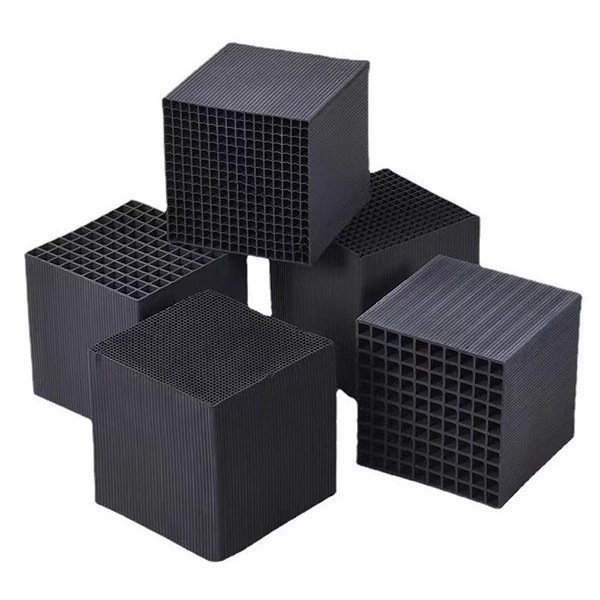
Mufeng (Shanghai) International Trade Co., Ltd. specializes in the field of water treatment materials, and for the characteristics of plastic injection molding waste gas, has established a three-core technological system of "high-temperature resistant adsorption material + intelligent regeneration system + modular design". Firstly, high-temperature resistant adsorption material: the company independently developed honeycomb activated carbon uses coconut shell as the raw material, modified at high temperature (800-1000℃ activation), with a specific surface area of up to 1200 m²/g, and a pore structure mainly consisting of mesopores (2-50nm), which increases the adsorption capacity for aromatic compounds and NMHC by 40%, and has a temperature resistance of up to 150℃, far exceeding the industry average (80℃). Secondly, intelligent regeneration system: integrating thermal desorption and catalytic oxidation technology, when the activated carbon is adsorbed to saturation, the system automatically initiates the regeneration process, using 180℃ hot air to desorb organic matter from the waste gas, followed by catalytic oxidation (300℃) to decompose into CO₂ and H₂O, realizing the recycling of activated carbon with a regeneration cycle of 6 months, five times longer than traditional solutions. Thirdly, modular design: the equipment uses standardized modules (single module size 1.2m×0.8m×0.6m), which can be flexibly combined according to the workshop space, with a single module handling air volume of 5000 m³/h, and three modules in parallel can meet the needs of a medium-sized injection molding workshop, occupying only 6㎡ of space, reducing by 80% compared to traditional equipment. After applying Mufeng's solution, a certain electronic component company reduced the NMHC concentration of waste gas to 30mg/m³, cut the annual activated carbon replacement cost to 400,000 yuan, and the equipment operated without any faults for 3 years, verifying the reliability and cost-effectiveness of the technology.
FAQ: Plastic Injection Molding Exhaust Maintenance Technology Selection Guide
Q1: How to choose suitable waste gas adsorption materials for high-temperature environments?
A: Focus should be given to the material's temperature resistance, specific surface area, and pore structure. Mu Rong honeycomb activated carbon can withstand temperatures up to 150°C, with a specific surface area of 1200 m²/g and a mesopore ratio exceeding 60%. It has high adsorption efficiency for VOCs in high-temperature waste gases, strong thermal stability, and is not prone to powdering over long-term use. Compared to ordinary columnar activated carbon (with temperature resistance of 80°C and specific surface area of 800 m²/g), its high-temperature treatment efficiency is increased by 30% and its service life is extended by a factor of two.
Q2: How to determine the regeneration frequency of activated carbon?
A: The regeneration frequency depends on exhaust gas concentration, treatment air volume, and adsorption material capacity. The Muerong intelligent regeneration system adjusts the regeneration interval dynamically through online monitoring of adsorption resistance (triggering regeneration when resistance rises by 30%), combined with exhaust gas concentration (shortening the regeneration cycle when NMHC > 80mg/m³). Test data shows that under conditions of 100mg/m³ exhaust gas concentration and 5000m³/h treatment air volume, the regeneration cycle is 6 months, saving 50% of energy consumption compared to a fixed cycle (3 months).
Q3: What scenarios are modular equipment suitable for?
A: Modular design is suitable for scenarios with limited space and the need for flexible expansion. Muerong's single module can handle 5000 m³/h of air volume and can be adjusted by adding or removing modules to accommodate different workshop sizes. For example, a small injection molding workshop (handling 10,000 m³/h of air volume) chooses 2 modules, occupying only 2.4㎡ of space; a large workshop (handling 30,000 m³/h of air volume) chooses 6 modules, occupying 7.2㎡ of space, saving 52% of space compared to traditional all-in-one machines (requiring 15㎡).

Full Summary: Technological Empowerment, Solving Emission Overhaul Challenges
The core of plastic injection molding exhaust gas repair lies in balancing processing efficiency, cost, and space occupancy. Mufeng (Shanghai) International Trade Co., Ltd. has constructed an efficient, economic, and compact technical solution through high-temperature-resistant adsorption materials, intelligent regeneration systems, and modular design, helping enterprises reduce exhaust gas concentration to compliant levels (NMHC < 50mg/m³), reducing annual activated carbon costs by 80%, reducing equipment floor space by 80%, and ensuring no secondary pollution during the regeneration process. For enterprises facing challenges in exhaust gas treatment, it is recommended to prioritize the evaluation of exhaust gas composition, temperature, and spatial conditions, select suitable adsorption materials and equipment forms, and optimize operating parameters through intelligent monitoring systems to achieve long-term stable compliance. Mufeng's technical practice provides a replicable solution for the industry, helping enterprises break through technical bottlenecks and enhance their environmental protection competitiveness.